The latest watch industry statistics show a market that is still expanding overall, even as some parts of the business are moving in different directions. Traditional watches, luxury watches, digital watches, and smartwatches are all contributing to the category, but growth is not uniform across price tiers, regions, or distribution channels.
Recent data points to a watch industry where premiumization remains strong, Swiss export values are still historically high despite a 2024 pullback, and smartwatches remain important even after their first annual shipment decline. At the same time, offline retail is still dominant, Asia Pacific remains the largest region for watch sales, and pre-owned demand is becoming more important for younger buyers.
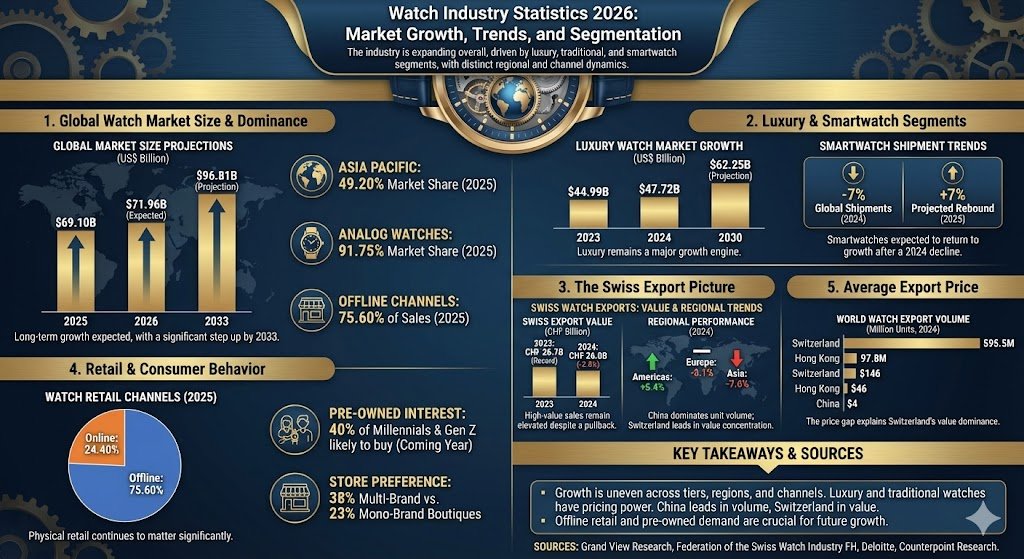
Grand View Research estimated the global watches market at $69.1 billion in 2025 and projected it would reach $96.81 billion by 2033.
Asia Pacific accounted for 49.20% of the global watches market in 2025.
Analog watches held 91.75% of the market in 2025, showing how dominant traditional formats still are.
Offline channels accounted for 75.60% of watch sales in 2025.
The global luxury watch market was valued at $44.99 billion in 2023 and $47.72 billion in 2024, with a projection of $62.25 billion by 2030.
The global digital watch market was estimated at $5.52 billion in 2024 and is projected to reach $7.54 billion by 2033.
Economy digital watches accounted for 42.28% of digital watch revenue in 2024.
Swiss watch exports reached a record CHF 26.7 billion in 2023 before slipping to CHF 26.0 billion in 2024.
Swiss wristwatch export volumes fell to 15.3 million units in 2024, down 9.4% year over year.
In Swiss watch exports, the Americas grew 5.4% in 2024, while Asia fell 7.6% and Europe was nearly flat at -0.1%.
The United States remained the leading Swiss watch export market in 2024, up 5.0%, while China fell 25.8% and Japan rose 7.8%.
Switzerland exported the equivalent of $29.5 billion in watches in 2024, representing more than half of global watch exports excluding connected watches.
China exported 595.5 million wristwatches in 2024 by unit volume, compared with 15.3 million from Switzerland.
The average export price of a Swiss watch was $1,837 in 2024, versus $4 for China.
Deloitte found 43% of industry executives had a negative outlook for their main export markets in 2025, while 61% planned to prioritize new product launches.
Two thirds of brands and retailers said online channels account for around 10% of their sales.
38% of consumers preferred multi-brand stores, compared with 23% who preferred mono-brand boutiques.
40% of millennials and Gen Z consumers said they were likely to buy a pre-owned watch in the coming year.
Counterpoint said global smartwatch shipments fell 7% in 2024, the first annual decline for the category.
Counterpoint later projected global smartwatch shipments would rebound by 7% in 2025.
Global watch market size statistics
One of the clearest signals in the watch industry is that the overall market is still expected to grow over the long term. Grand View Research estimated the market at $69.1 billion in 2025, with a further step up expected in 2026 and a much larger market by 2033.
That broader market view also helps explain why the industry can support multiple product tiers at the same time. Grand View Research said Asia Pacific held 49.20% of the market in 2025, analog watches held 91.75%, and offline retail still accounted for 75.60% of sales.
Luxury watch market statistics
The luxury end of the watch industry remains one of the most important growth engines. Grand View Research valued the luxury watch market at $44.99 billion in 2023, rising to $47.72 billion in 2024, and projected it would reach $62.25 billion by 2030.
Luxury demand is still a major force in the category, but it is also where some of the sharpest regional contrasts are appearing. That is especially clear in Swiss export data, where high-value sales remain elevated even as unit volumes have weakened.
Swiss watch export statistics
Swiss watch exports remain one of the best ways to track the high end of the industry. The Federation of the Swiss Watch Industry said exports hit a record CHF 26.7 billion in 2023, then declined 2.8% to CHF 26.0 billion in 2024. Watches accounted for CHF 24.8 billion of that 2024 total, while units fell 9.4% to 15.3 million.
Label
Bar
Value
2023
CHF 26.7B
2024
CHF 26.0B
Max = CHF 26.7B. Widths: 2023 100.00%, 2024 97.38%
Regional performance was uneven in 2024. The Americas were the most dynamic area at +5.4%, Europe was essentially flat at -0.1%, and Asia fell 7.6%. Among major markets, the United States rose 5.0%, China fell 25.8%, Hong Kong fell 18.7%, Japan rose 7.8%, and the United Kingdom slipped 1.6%.
World watch export volume statistics
When the industry is measured by unit volume rather than value, the rankings look very different. In the Federation of the Swiss Watch Industry’s global trade data, China dominated wristwatch export volume in 2024, while Switzerland exported far fewer units at much higher average prices. These world trade figures exclude connected watches.
Label
Bar
Value
China
595.5M units
Hong Kong
97.8M units
Switzerland
15.3M units
Germany
12.4M units
USA
10.5M units
Max = 595.5M units. Widths: China 100.00%, Hong Kong 16.42%, Switzerland 2.57%, Germany 2.08%, USA 1.76%
This chart makes the industry’s structure obvious. China leads on scale, while Switzerland leads on value concentration, brand prestige, and pricing power rather than sheer unit output.
Average export price statistics
The Federation of the Swiss Watch Industry also publishes average export prices for leading exporting countries. These are export prices rather than retail prices, but they still show just how far apart the industry’s business models are.
Label
Bar
Value
China
US$4
Hong Kong
US$46
Germany
US$146
USA
US$150
Switzerland
US$1,837
Max = US$1,837. Widths: China 0.22%, Hong Kong 2.50%, Germany 7.95%, USA 8.17%, Switzerland 100.00%
That gap in average export price is one of the biggest reasons Swiss watch exports can stay globally dominant in value even when the country exports a much smaller number of units than China.
Watch retail and consumer behavior statistics
Even with e-commerce growth, the industry is still heavily store-led. Grand View Research estimated offline channels represented 75.60% of watch sales in 2025. Deloitte’s 2025 study also found that two thirds of brands and retailers said online channels account for only around 10% of their sales, which helps explain why physical retail continues to matter so much in watches.
Label
Bar
Value
Offline
75.60%
Online
24.40%
Max = 75.60%. Widths: Offline 100.00%, Online 32.28%
Retail preferences are also shifting. Deloitte found that 38% of consumers preferred multi-brand stores versus 23% for mono-brand boutiques. It also found 40% of millennials and Gen Z were likely to buy a pre-owned watch in the coming year, suggesting the secondary market is becoming more important to future demand.
Smartwatch statistics
Smartwatches remain a major part of the broader watch industry, even though 2024 was a rare down year. Counterpoint said global smartwatch shipments fell 7% in 2024, marking the first annual decline for the category. Apple still held the top position, but Counterpoint said its shipments fell 19% year over year.
Even with that setback, Counterpoint later projected that global smartwatch shipments would swing back to 7% growth in 2025. That suggests the connected watch segment is still structurally important, but it is behaving more like a maturing consumer electronics category than an early-stage growth market.
What these watch industry statistics show
The biggest takeaway is that the watch industry is not moving in a single direction. Traditional and luxury watches continue to benefit from pricing power, heritage, and collector demand, while digital and smartwatch products keep the broader category relevant for mass-market and health-focused buyers.
At the same time, the data shows clear segmentation. China dominates export units, Switzerland dominates export value, offline retail still matters more than many other consumer categories, and pre-owned demand is rising with younger consumers. In other words, the industry is growing, but it is doing so through a mix of luxury concentration, regional divergence, and product specialization.