These men’s fashion industry statistics show how large the menswear market has become, where regional demand is strongest, how quickly online sales are scaling, and which product and fabric attributes matter most to shoppers. The latest figures point to a category that is still expanding, but with growth increasingly tied to value, convenience, comfort, and quality.
Men’s Fashion Industry Statistics (Top Highlights)
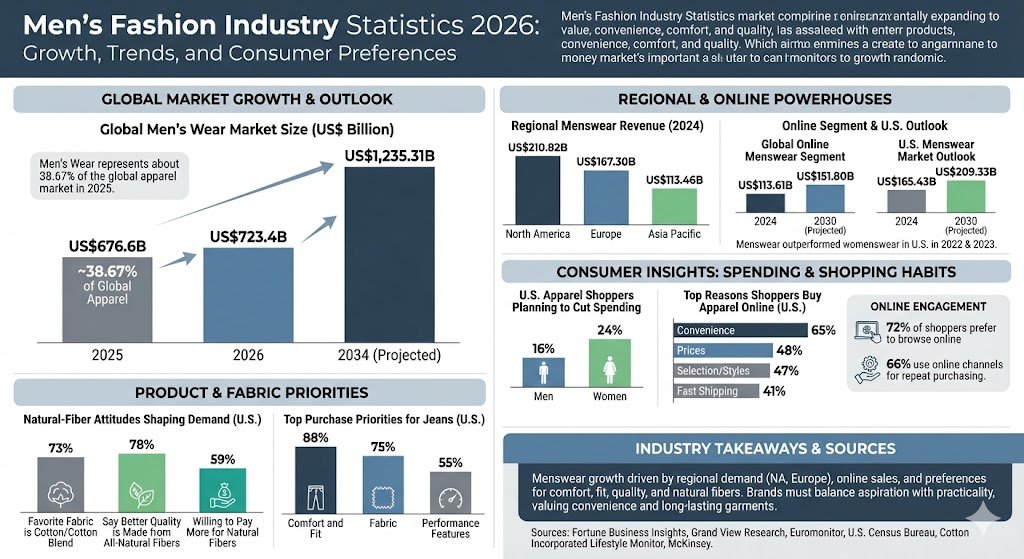
The global men’s wear market was valued at US$676.6 billion in 2025 and is projected to reach US$723.4 billion in 2026.
Fortune Business Insights projects the global men’s wear market will reach US$1,235.31 billion by 2034.
Based on Fortune Business Insights estimates for menswear and total apparel, men’s wear represented about 38.67% of the global apparel market in 2025.
The U.S. menswear market generated US$165.43 billion in 2024 and is projected to reach US$209.33 billion by 2030.
In 2024, regional menswear revenue reached US$210.82 billion in North America, US$167.30 billion in Europe, and US$113.46 billion in Asia Pacific.
The global online menswear segment generated US$113.61 billion in 2024 and is projected to reach US$151.80 billion by 2030.
Euromonitor said womenswear was about 1.5 times the size of menswear in the U.S. in 2023, but menswear outperformed womenswear in 2022 and 2023.
In Euromonitor’s U.S. apparel and footwear survey, 16% of men planned to cut spending versus 24% of women.
Cotton Incorporated found 72% of shoppers prefer to browse apparel online, while 66% use online channels for repeat purchasing.
Among U.S. shoppers, 73% said cotton or a cotton blend is their favorite fabric to wear, 78% said better quality garments are made from all-natural fibers, and 59% said they are willing to pay more for clothing made from natural fibers.
For jeans purchases, 88% of U.S. shoppers said comfort and fit matter most, ahead of fabric at 75% and performance features at 55%.
Global men’s wear market size
Label
Bar
Value
2025
US$676.6B
2026
US$723.4B
2034
US$1,235.31B
Max = US$1,235.31B. Widths: 2025 54.77%, 2026 58.56%, 2034 100.00%
Regional menswear market revenue in 2024
Label
Bar
Value
North America
US$210.82B
Europe
US$167.30B
Asia Pacific
US$113.46B
Max = US$210.82B. Widths: North America 100.00%, Europe 79.36%, Asia Pacific 53.82%
U.S. menswear market outlook
Label
Bar
Value
2024
US$165.43B
2030
US$209.33B
Max = US$209.33B. Widths: 2024 79.03%, 2030 100.00%
Global online menswear segment
Label
Bar
Value
2024
US$113.61B
2030
US$151.80B
Max = US$151.80B. Widths: 2024 74.84%, 2030 100.00%
U.S. apparel shoppers planning to cut spending
Label
Bar
Value
Men
16%
Women
24%
Max = 24%. Widths: Men 66.67%, Women 100.00%
Top reasons shoppers buy apparel online in the U.S.
Label
Bar
Value
Convenience
65%
Prices
48%
Selection/styles
47%
Fast shipping
41%
Max = 65%. Widths: Convenience 100.00%, Prices 73.85%, Selection/styles 72.31%, Fast shipping 63.08%
Natural-fiber attitudes shaping apparel demand
Label
Bar
Value
Favorite fabric is cotton/cotton blend
73%
Say better quality is made from all-natural fibers
78%
Willing to pay more for natural fibers
59%
Max = 78%. Widths: Favorite fabric is cotton/cotton blend 93.59%, Say better quality is made from all-natural fibers 100.00%, Willing to pay more for natural fibers 75.64%
Top purchase priorities when shoppers buy jeans
Label
Bar
Value
Comfort and fit
88%
Fabric
75%
Performance features
55%
Max = 88%. Widths: Comfort and fit 100.00%, Fabric 85.23%, Performance features 62.50%
What these men’s fashion industry statistics show
The numbers point to a menswear market that is still growing globally, but not just because of runway trends or premium launches. Growth is being supported by big regional demand in North America and Europe, a large online sales base, and consumer preferences that favor comfort, fit, repeatable basics, and fabrics that feel durable and high quality.
They also show why menswear brands are balancing aspiration with practicality. Even in a category that continues to expand, many consumers remain price-conscious, value online convenience, and increasingly connect quality with natural fibers and long-lasting garments. That lines up with McKinsey’s broader view that fashion is entering 2026 in a low-growth environment where agility, sharper value propositions, and better consumer targeting matter more than ever.
Sources
Fortune Business Insights, Mens Wear Market, March 2026.
Fortune Business Insights, Apparel Market, March 2026.
Grand View Research, Men’s Wear Market Summary, 2024 and 2030 outlook pages for global, U.S., North America, Europe, Asia Pacific, and online menswear.
Euromonitor, US Apparel & Footwear: Short-Term Shifts or Long-Term Movements in 5 Charts, July 2024.
U.S. Census Bureau, Quarterly Retail E-Commerce Sales, March 2026.
Cotton Incorporated Lifestyle Monitor, At NRF’s Big Show: Holiday Recap & What’s in Store for 2025, January 2025.
Cotton Incorporated Lifestyle Monitor, The Fashion Week Buzz: The Spring Scene Will Be Full of Natural Fibers, September 2025.
Cotton Incorporated Lifestyle Monitor, Scenes From NYFW: Cotton’s Role in Modern Fashion, February 2026.
Cotton Incorporated Lifestyle Monitor, Consumers & Brands Explain Why These Pieces Are the Foundation of Every Wardrobe, February 2026.
McKinsey, The State of Fashion 2026: When the Rules Change, November 2025.