
10 Best Watch Timing Machines Under $50 for Accurate Mechanical Watch Testing in 2026
Finding reliable watch timing machines under $50 can make basic mechanical-watch testing more accessible without requiring professional workshop equipment. The right tool can help you check rate, amplitude, beat error, and timing stability before making adjustments.
This roundup compares affordable timegraphers and related watch-repair tools, focusing on useful functions, ease of operation, included accessories, and the limitations to expect at this price.
Page Contents
- Best 10 Watch Timing Machines Under 50 Picks for 2026
- Best Overall Watch Timing Machine – Multifunction Timegrapher
- Best for Small Businesses – Passcode Time Clock
- Best for Computer Connectivity – Mechanical Watch Calibrator
- Best Multifunction Watch Tool – Quartz and Battery Tester
- Best Budget Watch Press Kit – Eventronic 16PCS Watch Press Tool
- Best Technical Watch Timing Machine – Howkun WEISHI No.1000 Timegrapher
- Best Compact Watch Case Closer – JOREST Watch Press Tool Set
- Best Budget Timegrapher – Mechanical Watch Calibration Tool
- Best Dual-Watch Pressure Tester – Watch Waterproof Tester
- Best Compact Pressure Tester – Dual Watch Waterproof Detector
- How We Picked the Best Watch Timing Machines Under 50
- Quick Comparison
- Key Buying Factors for Watch Timing Machines Under 50
- Who Should Buy Which Watch Timing Machines Under 50?
- Read More Articles
- Best Watch Timing Machine For Home Use
- Best Watch Timing Machines For Hobbyists
- Best Watch Timing Machines For Watchmakers
- Best Watch Timing Machines For Small Workshops
- Best Watch Timing Machine Under 200
- Best Jewelry Magnifiers
- Best Illuminated Jewelry Magnifiers
- Best Folding Jewelry Magnifiers
- Best Jewelry Magnifiers With Multiple Magnification Levels
- Best Jewelry Magnifiers For Watches
Best 10 Watch Timing Machines Under 50 Picks for 2026
Best Overall Watch Timing Machine

- Measures rate, amplitude, beat error, and waveform data
- Adjustable jaws fit various dial sizes
- USB/RS232 computer data transfer
Best For: Mechanical-watch calibration and detailed timing analysis
Best for Small Businesses

- Auto-feeds and aligns compatible time cards
- Includes 50 cards and an ink ribbon
- Two-color printing highlights attendance exceptions
Best For: Indoor punch-card employee attendance tracking
Best Multifunction Watch Tool

- Combines demagnetizer, quartz, battery, and pulse testing
- Adjustable demagnetization speed
- Runs on two AA batteries
Best For: Portable watch repair and basic diagnostics
Best Budget Watch Press Kit
Eventronic 16PCS Watch Press Tool
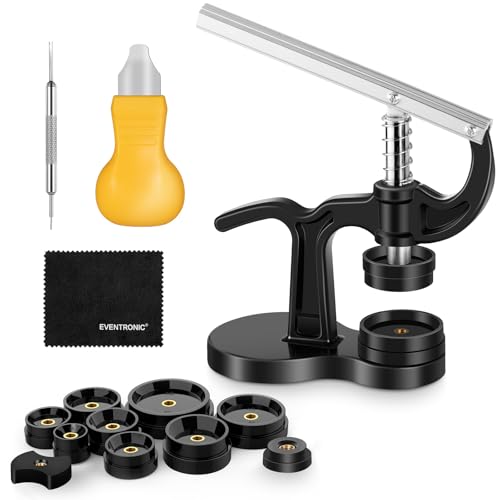
- 12 dies for 18mm–50mm cases
- Weighted base and controlled handle
- Includes spring bar tool and pry opener
Best For: Beginners closing snap-back cases at home
Best Technical Watch Timing Machine
Howkun WEISHI No.1000 Timegrapher

- Measures rate, amplitude, and beat error
- Six testing positions with adjustable sampling
- Supports automatic and manual beat-rate selection
Best For: Hobbyist watchmakers analyzing mechanical movements
Best Compact Watch Case Closer

- Controlled rotating-handle pressure
- Fits round dials from 22mm to 42mm
- Designed for pry-open backs with stabilizing film
Best For: Home users closing compatible round watch cases
Best Budget Timegrapher
Mechanical Watch Calibration Tool

- High-sensitivity vibration sensor
- Noise-reduction sound-insulated cavity
- Battery-powered, lightweight design
Best For: Basic mechanical watch timing checks
Best Dual-Watch Pressure Tester

- Tests two watches at once
- 0.3–6.0 bar pressure range
- Transparent chamber and large gauge
Best For: Watch-case water-resistance testing
Best Compact Pressure Tester
Dual Watch Waterproof Detector

- Tests two watches simultaneously
- Transparent cylinder and pressure dial
- Compact 9.5 × 5.5 × 10.6-inch footprint
Best For: Space-conscious waterproof testing
Best Overall Watch Timing Machine – Multifunction Timegrapher
For shoppers comparing watch timing machines under 50, this multifunction timegrapher offers a practical set of measurements for mechanical-watch calibration. It displays daily rate, amplitude, beat error, frequency, signal value, polarization, oscillation, and waveform data, with adjustable settings for frequency and lift angle.
Best For: Mechanical-watch owners and hobbyists who want broad calibration data plus computer connectivity.
Pros:
- Measures daily rate, amplitude, beat error, frequency, and waveform information.
- Adjustable sliding jaws accommodate different watch dial sizes.
- Supports data transfer to tablets, laptops, and desktops through USB/RS232 connectivity.
- Compact, lightweight design with a visible red power indicator.
Cons:
- Designed for mechanical-watch calibration rather than employee timekeeping.
- Its range of settings may require familiarity with timing-machine adjustments.
This is the strongest all-around option in the group for users who want detailed mechanical-watch readings and a way to move results to a computer. The adjustable holder also makes it more flexible than a fixed-size tester.
Best for Small Businesses – Passcode Time Clock
Although it is not a mechanical-watch tester, this passcode time clock is a useful alternative for shoppers whose search for watch timing machines under 50 actually means an employee attendance clock. It automatically feeds and aligns 7.1-by-2.4-inch time cards and records attendance with two-color printing.
Best For: Small offices and businesses that need straightforward punch-card attendance tracking.
Pros:
- Includes 50 time cards and one ink ribbon cartridge.
- Auto-align and auto-feed functions help handle correctly inserted cards.
- Passcode access protects the settings mode.
- Two-color printing distinguishes on-time punches from lateness or early departures.
Cons:
- Only suitable for compatible 7.1-by-2.4-inch time cards.
- It is an employee time clock, not a watch movement timing machine.
- Designed for indoor, corded operation.
This product belongs in an attendance-equipment category rather than a watch-repair toolkit. Choose it only if you need punch-card workforce tracking; mechanical-watch users should consider one of the dedicated calibrators instead.
Best for Computer Connectivity – Mechanical Watch Calibrator
This mechanical watch calibrator is a solid candidate among watch timing machines under 50 when transferring readings to a computer matters. It combines signal and frequency testing with waveform display, an adjustable holder, and a data-transfer terminal compatible with tablets, laptops, and desktops.
Best For: Watchmakers and technically minded hobbyists who want a compact calibrator with computer integration.
Pros:
- Supports signal-value measurements, frequency settings, and waveform displays.
- Soft-iron guide rail is designed to transmit sound data to the meter.
- Removable sliding jaws hold different watch sizes securely.
- Data can be uploaded to compatible computers and tablets upon connection.
Cons:
- The supplied notes do not specify a display size or included accessories.
- Its professional measurement functions may be more than casual users need.
With its metal body, adjustable clips, and computer-transfer terminal, this model emphasizes practical workshop use. It is especially appealing if you plan to review or store timing data digitally rather than rely only on an onboard reading.
Best Multifunction Watch Tool – Quartz and Battery Tester
For buyers looking beyond rate measurement, this compact tool expands the usual watch timing machines under 50 search with demagnetization, quartz testing, battery checking, and pulse testing. It runs on two AA batteries, which are not included, and is designed for watch repair work.
Best For: Watch-repair users who need several basic diagnostic and maintenance functions in one portable device.
Pros:
- Combines demagnetization, quartz movement testing, battery testing, and pulse testing.
- Adjustable demagnetization speed supports different repair tasks.
- Pulse testing can check battery condition without opening the watch case.
- Compact, battery-powered format is convenient for portable use.
Cons:
- Two AA batteries are required but not included.
- It is a multifunction repair tester rather than a dedicated mechanical timegrapher.
- Supplied dimensions and packaging information are inconsistent, so portability should be verified before purchase.
This is the most versatile choice for basic watch servicing, particularly when demagnetizing and battery checks are as important as timing-related tests. Choose a dedicated timegrapher if you need detailed mechanical rate and beat-error readings.
Best Budget Watch Press Kit – Eventronic 16PCS Watch Press Tool
If you are comparing watch timing machines under 50, note that this Eventronic kit serves a different purpose: it is a manual case-closing and battery-repair tool set. Its weighted base, 12 dies, and controlled handle make it useful for hands-on watch maintenance.
Best For: Home users and beginners who need a watch press for round snap-back cases and basic band work.
Pros:
- Includes 12 dies covering watch sizes from 18mm to 50mm.
- Weighted stabilization and a non-slip aluminum handle support controlled pressing.
- Nylon dies are designed to help prevent scratches and withstand repeated use.
- Includes a spring bar tool, pry opener, cleaning cloth, instructions, and video guidance.
Cons:
- This is a manual watch press, not an electronic timing machine.
- The pry opener is intended only for watches with pry-open backs.
Choose this kit when your priority is closing snap-back cases rather than measuring accuracy, amplitude, or beat error. Its broad die selection and beginner-oriented support make it a practical repair accessory.
Best Technical Watch Timing Machine – Howkun WEISHI No.1000 Timegrapher
For shoppers specifically seeking watch timing machines under 50, the Howkun WEISHI No.1000 is the purpose-built option in this selection. It measures rate, amplitude, beat error, and beat rate in real time, making it more suitable for diagnosing mechanical watch performance than a manual repair kit.
Best For: Hobbyist watchmakers and home users who want multi-position timing measurements with an LCD readout.
Pros:
- Displays rate, amplitude, beat error, and beat rate in real time.
- Supports six testing positions and selectable sampling periods from 2 to 60 seconds.
- Automatically recognizes common beat rates and offers extensive manual beat-rate selection.
- Includes a microphone, power adapter, and English user manual.
Cons:
- It does not include a printer connection.
- The unit is relatively substantial at 1.7kg.
- It requires a 90–220V two-wire power supply rather than battery operation.
This is the clear match for buyers who need actual timing analysis. Its broad beat-rate support and six-position testing provide useful diagnostic flexibility, while the lack of printing keeps the feature set focused on on-screen readings.
Best Compact Watch Case Closer – JOREST Watch Press Tool Set
Among products considered alongside watch timing machines under 50, the JOREST set is a compact manual case-closing alternative. It uses slow, vertical pressure and a protective film to help stabilize round watches while pressing pry-open backs into place.
Best For: Home repair users working on round watches measuring 22mm to 42mm with pry-opening backs.
Pros:
- Rotating handle enables slower, more controlled downward pressing.
- Vertical pressure is designed to maximize force while reducing resistance.
- Protective film helps limit case movement during closing.
- Compact hand-powered design with an English instruction manual.
Cons:
- Only fits round dials from 22mm to 42mm.
- Not suitable for square or oval watches, screw-back cases, or cases with multiple grooves.
- Requires simple assembly before first use.
Pick this tool when precise, controlled case pressing matters more than movement measurement. Its narrower compatibility makes it less versatile than a larger press kit, but the guided pressure and stabilizing film can be helpful for the specified round, pry-open cases.
Best Budget Timegrapher – Mechanical Watch Calibration Tool
For shoppers comparing watch timing machines under 50, this battery-powered timegrapher offers a compact way to evaluate mechanical watch performance. Its vibration sensor, sound-insulated cavity, and sound amplification system are designed for clear movement monitoring during testing.
Best For: Hobbyists and watch owners who need a basic mechanical watch timing tester.
Pros:
- High-sensitivity vibration sensor detects subtle watch sounds.
- Enclosed noise-reduction and sound-insulation cavity supports clearer readings.
- Headphone monitoring is available, and the test does not magnetize the watch.
- Lightweight 0.13 kg design and battery-powered operation.
Cons:
- Designed for timing measurement rather than waterproof testing or other repair tasks.
- Battery power may require keeping replacement batteries available.
This is the most directly relevant option here for timing checks, especially if you want a small, straightforward tester for mechanical watches rather than a case pressure tool.
Best Dual-Watch Pressure Tester – Watch Waterproof Tester
Although it is not a timing machine, this watch waterproof tester may appeal to buyers comparing watch timing machines under 50 who also need a practical repair-shop testing tool. It uses an adjustable 0.3–6.0 bar air-pressure system to evaluate watch-case sealing.
Best For: Watch repair users checking water resistance on quartz and mechanical watches.
Pros:
- Supports simultaneous testing of two watches.
- Transparent glass chamber and large pressure gauge make pressure monitoring easier.
- Accommodates most watches up to 2.6 inches in diameter and 2.8 inches in height.
- Glass, aluminum alloy, and rubber construction is designed for repeated use.
Cons:
- Tests waterproof sealing, not timing accuracy or rate performance.
- No warranty is listed in the supplied details.
Choose this model only if your priority is case water-resistance evaluation. For mechanical rate and beat-error checks, the dedicated timegrapher above is the better match.
Best Compact Pressure Tester – Dual Watch Waterproof Detector
This compact pressure tester is another alternative for shoppers browsing watch timing machines under 50, but its function is watch-case water-resistance testing rather than timing measurement. It can test two watches simultaneously and uses a transparent cylinder with a pressure dial for visual inspection.
Best For: Repair users who need a compact dual-watch waterproof testing setup.
Pros:
- Tests two watches at the same time for improved workflow.
- Transparent glass cylinder helps reveal potential case sealing problems.
- Supports watches up to 2.6 inches in diameter and 2.8 inches in height.
- Compact 9.5 × 5.5 × 10.6-inch design is easier to store in limited space.
Cons:
- Not a watch timing machine or mechanical movement rate tester.
- The supplied notes list a 0.3–0.6 bar air-pressure range, which may limit testing compared with higher-range pressure tools.
This model makes sense when storage space and dual-watch testing matter most. If your goal is to regulate or diagnose mechanical timekeeping, look for the dedicated timing tester instead.
How We Picked the Best Watch Timing Machines Under 50
We focused on tools that support practical watch testing or closely related repair tasks while staying below the $50 price point. Priority went to products with clearly stated measurement functions, readable displays, acoustic pickups, timing analysis, demagnetization, or useful watch-repair accessories.
Because this category includes both dedicated timegraphers and broader watch-service tools, we separated timing equipment from presses, waterproof testers, and battery or demagnetizing devices. This helps clarify which products measure movement performance and which ones support maintenance around the timing process.
Quick Comparison
| Tool Type | Best For | Important Consideration |
|---|---|---|
| Basic timegrapher | Rate, amplitude, and beat-error checks | Accuracy depends on pickup and setup |
| Multifunction timing machine | Hobbyists wanting broader testing | Controls and readings may require practice |
| Demagnetizer or quartz tester | Battery-watch and magnetism troubleshooting | Not a substitute for mechanical timing analysis |
| Watch press or repair kit | Battery and case maintenance | Does not measure movement performance |
| Waterproof tester | Case resistance checks | Use carefully and follow pressure limits |
Key Buying Factors for Watch Timing Machines Under 50
Measurements and Movement Compatibility
Look for the readings you actually need, such as daily rate, beat error, amplitude, beat frequency, and lift angle support. A basic timegrapher is most useful for mechanical and automatic movements. Quartz testers and demagnetizers address different problems, so confirm compatibility before buying.
Pickup Quality and Stability
An acoustic sensor or pickup rail should hold the watch securely and capture a consistent signal. Noise, vibration, an unsuitable case position, or a weak movement can produce unstable results. A low-cost machine is more useful when it offers repeatable readings rather than simply displaying many functions.
Display and Controls
Choose a clear screen with straightforward controls for beat rate, test duration, and measurement mode. If you are new to regulation, readable graphs or trend information can be more helpful than a crowded interface.
Build Quality and Included Accessories
Check whether the package includes a pickup, power adapter, holder, instructions, or replacement parts. Metal housings may improve durability, while compact plastic units can be easier to store. Also verify voltage, connector type, and return coverage.
Who Should Buy Which Watch Timing Machines Under 50?
Choose a dedicated timegrapher if you regulate or diagnose mechanical watches regularly. It is the most direct option for checking whether a movement is running fast, slow, or inconsistently. A multifunction model suits hobbyists who want additional display or testing modes, provided they are willing to learn the controls.
Choose a quartz tester or demagnetizer when your work mainly involves battery-powered watches or suspected magnetization. A watch press kit is better for battery replacement and case-back work, while a waterproof tester is intended for checking case resistance—not movement timing. For occasional home use, prioritize clear readings, stable pickup, and dependable operation over an unusually long feature list.