
10 Best Watch Timing Machines for Watchmakers in 2026: Precision Testing Guide
Choosing the right timegrapher can make mechanical-watch regulation faster, more consistent, and easier to verify. The best watch timing machines for watchmakers provide clear rate, amplitude, beat error, and beat-per-hour readings without adding unnecessary complexity.
This roundup compares 10 multifunction timing testers suited to bench work, servicing, troubleshooting, and calibration. Use the guide below to match the display, pickup system, measurement range, and workflow to your needs.
Page Contents
- Best 10 Watch Timing Machines for Watchmakers Picks for 2026
- Precision Bench Choice – SWANSOFT No.1000 Timegrapher
- Versatile Collector Pick – YaeTek No.1000 Watch Timing Machine
- Simple Professional Tool – NO.1000 Multifunction Timegrapher
- Portable Diagnostic Option – Pongnas Multifunction Timegrapher
- Best High-Resolution Pick – TICFROG No.1900 Timegrapher
- Best for Computer Workflows – Adjustable USB/RS232 Timegrapher
- Best Simple LCD Value – SWANSOFT No.1900 Timegrapher
- Best Beginner Pick – TICFROG No.1000 Watch Timegrapher
- Most Adjustable Tester – Multifunctional No.1000 Watch Timegrapher
- Best Compact Option – TICFROG No.1000 Mechanical Watch Tester
- How We Picked the Best Watch Timing Machines for Watchmakers
- Quick Comparison
- Key Buying Factors for Watch Timing Machines
- Who Should Buy Which Watch Timing Machines for Watchmakers?
- Read More Articles
- Best Watch Timing Machine
- Best Compact Watch Timing Machines
- Best Watch Timing Machines With Carrying Cases
- Best Watch Timing Machine For Home Use
- Best Watch Timing Machines For Hobbyists
- Best Watch Timing Machines For Small Workshops
- Best Watch Timing Machine Under 200
- Best Watch Timing Machines Under 50
- Best Jewelry Magnifiers
- Best Illuminated Jewelry Magnifiers
Best 10 Watch Timing Machines for Watchmakers Picks for 2026
Precision Bench Choice
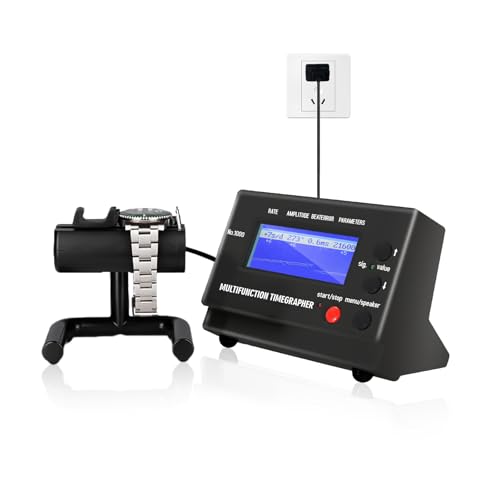
- Claims ±0.1 s/d accuracy with 50-sample averaging
- Displays rate, amplitude, beat error, and lift angle
- Tests six positions on mechanical movements
Best For: Professional movement diagnostics and calibration
Versatile Collector Pick
YaeTek No.1000 Watch Timing Machine
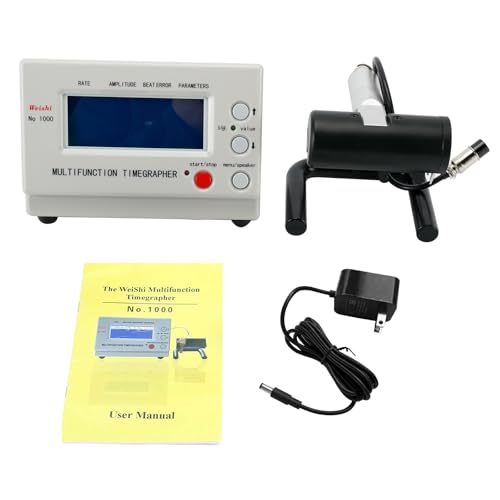
- Automatically calculates rate, amplitude, and beat error
- Supports six testing positions
- Offers 2–60-second sampling periods
Best For: Collectors and hobbyist mechanical-watch testing
Simple Professional Tool
NO.1000 Multifunction Timegrapher

- Tests almost all mechanical watches
- Compact corded-electric design
- Measures beats per unit time
Best For: Basic mechanical-watch timing checks
Portable Diagnostic Option
Pongnas Multifunction Timegrapher

- Shows rate, amplitude, beat error, and frequency
- Measures beat error to 0.1 milliseconds
- Portable design with swing measurement
Best For: Portable mechanical-watch diagnostics
Best High-Resolution Pick

- Color screen with two trace colors
- Measures rate, amplitude, and beat error
- Supports one to six measuring positions
Best For: Watchmakers needing clearer traces for adjustment and diagnosis
Best for Computer Workflows
Adjustable USB/RS232 Timegrapher

- Transfers data through USB/RS232
- Displays rate, frequency, and waveform data
- Adjustable jaws fit various dial sizes
Best For: Benches that combine timing checks with digital data handling
Best Simple LCD Value

- Large high-resolution backlit LCD
- Displays five live timing measurements
- Includes sensor, adapter, and manual
Best For: Users wanting an easy-to-read tester for mechanical watches
Best Beginner Pick
TICFROG No.1000 Watch Timegrapher

- Measures beat rate, beat error, and amplitude
- Displays readings graphically and numerically
- Includes sensor, adapter, manual, and cloth
Best For: Novice watchmakers learning mechanical-watch timing
Most Adjustable Tester
Multifunctional No.1000 Watch Timegrapher
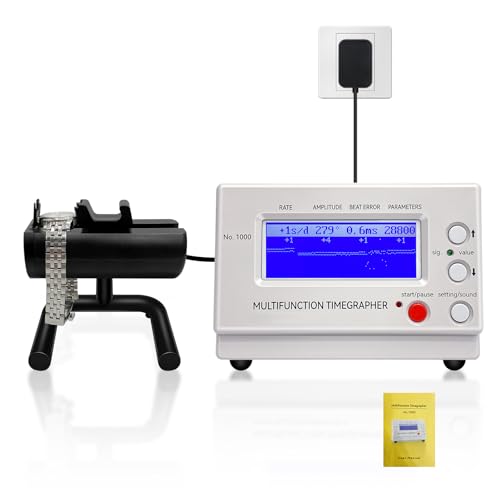
- Tests rate, amplitude, polarity, beat, lift angle, and period
- Supports adjustable sampling and directional measurements
- Provides acoustic sensing and wide-voltage input
Best For: Technicians needing flexible mechanical-movement diagnostics
Best Compact Option
TICFROG No.1000 Mechanical Watch Tester

- Reports beat rate, beat error, and amplitude
- Includes sensor, adapter, manual, and cleaning cloth
- Compact setup for routine mechanical-watch checks
Best For: Hobbyists wanting a straightforward, portable tester
Precision Bench Choice – SWANSOFT No.1000 Timegrapher
For watchmakers who need detailed diagnostics, this SWANSOFT No.1000 is one of the more feature-rich watch timing machines for watchmakers. It is designed for mechanical movements and displays rate, amplitude, beat error, lift angle, and timing curves on a color LCD.
Best For: Professional servicing, movement calibration, and diagnosing antique or faulty mechanical watches.
Pros:
- Claims ±0.1 seconds/day accuracy using a 50-sample average.
- Measures rate, amplitude, beat error, and adjustable lift angle.
- Supports six testing positions and 2–60-second sampling cycles.
- Includes a sensor, US adapter, manual, and 12-month support.
Cons:
- Only supports mechanical watches, not quartz movements.
- Its broad diagnostic feature set may be more than casual collectors need.
The No.1000 is a strong choice when readable live graphs and multiple measurements matter more than a basic pass-or-fail timing check.
Versatile Collector Pick – YaeTek No.1000 Watch Timing Machine
The YaeTek No.1000 is a practical option for collectors and hobbyist watchmakers comparing mechanical movement performance. Its LCD automatically calculates rate, amplitude, and beat error while showing a visual representation of the watch’s tick-tock signal.
Best For: Mechanical watch collection checks and straightforward bench testing with adjustable sampling.
Pros:
- Automatically calculates rate, amplitude, and beat error.
- Offers six adjustable testing positions.
- Provides sampling periods from 2 to 60 seconds.
- Uses a 110V–220V US plug configuration.
Cons:
- It is intended for mechanical watches rather than quartz watches.
- The supplied notes list ±1 s/d precision, which is less precise than the SWANSOFT model’s stated figure.
With automatic signal adjustment and flexible sampling, this YaeTek model offers useful core functions without focusing on advanced display features.
Simple Professional Tool – NO.1000 Multifunction Timegrapher
This compact NO.1000 timegrapher keeps the focus on essential timing analysis for mechanical watches. As one of the simpler watch timing machines for watchmakers, it uses a corded electric power source and is designed to measure beats per unit time.
Best For: Watchmakers and collectors seeking a compact, basic timing tester for mechanical watches.
Pros:
- Designed to test almost all mechanical watches.
- Provides multifunction timing analysis in a compact format.
- Uses a corded electric power source.
- Has CE specification compliance listed in the product details.
Cons:
- The supplied notes do not specify amplitude, beat-error, or lift-angle readings.
- It does not appear intended for quartz watches.
This model is worth considering when core mechanical-watch timing measurement and a compact footprint are the priorities, but buyers wanting extensive diagnostics should compare its display functions carefully.
Portable Diagnostic Option – Pongnas Multifunction Timegrapher
The Pongnas watch tester is a portable choice for users who want real-time readings from a mechanical movement. It calculates rate, amplitude, and beat error while adding frequency, polarization, and swing displays for a broader view of timing performance.
Best For: Portable mechanical-watch checks where real-time data and basic diagnostic measurements are useful.
Pros:
- Displays rate, amplitude, beat error, and frequency data in real time.
- Measures beat error from 0 to 9.9 milliseconds with 0.1-millisecond resolution.
- Measures swing from 100 to 360 degrees.
- Designed for portable installation and operation.
Cons:
- The supplied dimensions appear unusually small, so buyers should verify the physical size before ordering.
- The notes do not specify testing positions or sampling intervals.
- It is described for mechanical watches, not quartz movements.
Pongnas is a sensible fit for users who value a portable instrument with several live measurements, although its less-detailed specifications make comparison with professional bench units harder.
Best High-Resolution Pick – TICFROG No.1900 Timegrapher
For watchmakers comparing watch timing machines for watchmakers, the TICFROG No.1900 stands out with a larger color display and two distinct trace colors. It measures rate deviation, amplitude, and beat error while showing beat number and lift angle live, making it useful for routine checks and troubleshooting mechanical and coaxial watches.
Best For: Hobbyists, collectors, and professional watchmakers who want clear visual traces and broad measurement coverage.
Pros:
- High-resolution color screen with yellow and light-blue traces for easier diagnosis.
- Measures rate deviation, amplitude, and beat error with live beat and lift-angle readings.
- Supports one to six measuring positions and AC 100V–240V power.
- Includes a sensor, US adapter, manual, and cleaning cloth.
Cons:
- Designed for mechanical and coaxial watches rather than quartz watches.
- The larger feature set may be more than casual users need.
The color traces and live readings make this a particularly practical choice when adjustment work or fault diagnosis matters more than basic rate checking.
Best for Computer Workflows – Adjustable USB/RS232 Timegrapher
This compact option is worth considering when shopping for watch timing machines for watchmakers with data-transfer needs. It supports daily rate, signal value, polarisation, oscillation frequency, and waveform display, while USB/RS232 connectivity allows readings to be uploaded to tablets, laptops, or desktops.
Best For: Watchmakers who want adjustable positioning and the ability to transfer calibration data to a computer.
Pros:
- Provides multiple readings, including daily rate, amplitude-related analysis, and waveform display.
- USB/RS232 data transfer supports tablet, laptop, and desktop workflows.
- Sliding, removable jaws accommodate different dial sizes.
- Compact 3.94-by-2.36-by-1.97-inch design.
Cons:
- The supplied notes do not specify screen details or included accessories.
- Computer connectivity may be unnecessary for users seeking only basic readings.
Its adjustable clips and computer-transfer capability make it a practical fit for benches where repeatable placement and recordkeeping are important.
Best Simple LCD Value – SWANSOFT No.1900 Timegrapher
The SWANSOFT No.1900 is a straightforward choice among watch timing machines for watchmakers who want an upgraded LCD interface. Its backlit color screen displays rate, amplitude, beat error, beat, and lift angle in real time, helping users evaluate how a mechanical watch is running.
Best For: Hobbyists, collectors, technicians, and watchmakers seeking an easy-to-read mechanical watch tester.
Pros:
- Larger, high-resolution backlit screen improves readability.
- Shows rate, amplitude, beat error, beat, and lift angle live.
- Simple interface is designed for easy operation.
- Package includes the timegrapher, sensor, US adapter, and professional manual.
Cons:
- Only suitable for mechanical movement watches and does not support quartz watches.
- The supplied notes do not mention multiple trace colors or computer data transfer.
For users who prioritize readable live measurements and uncomplicated operation, the SWANSOFT No.1900 offers a focused setup for checking mechanical watch performance.
Best Beginner Pick – TICFROG No.1000 Watch Timegrapher
For beginners comparing watch timing machines for watchmakers, the TICFROG No.1000 focuses on the core measurements needed to evaluate a mechanical watch. It displays beat rate, beat error, and balance-wheel amplitude both numerically and graphically, while its sensor detects escapement sounds or vibrations.
Best For: Novice watchmakers learning to interpret mechanical-watch accuracy readings.
Pros:
- Measures beat rate, beat error, and amplitude.
- Shows results graphically and numerically.
- Includes a timegrapher sensor, US adapter, manual, and cleaning cloth.
- Automatic signal-level adjustment supports straightforward operation.
Cons:
- Designed for mechanical watches rather than water-resistant or electronic testing.
- Users should consult the manual before operating advanced functions.
This is a practical entry-level option when you need essential timing information without a more complex feature set. Its 18-month satisfaction guarantee and stated customer-service response time add reassurance for first-time users.
Most Adjustable Tester – Multifunctional No.1000 Watch Timegrapher
This multifunctional model is a strong contender among watch timing machines for watchmakers who want broader measurement controls. It tests daily rate, beat amplitude, polarity, beat, lift angle, and period, with automatic standard-beat detection plus manual selection for special beats.
Best For: Watchmakers and technicians who need flexible sampling and directional testing for mechanical movements.
Pros:
- Supports 1–6 directional measurements and a 2–60-second sampling period.
- Offers a 100°–360° amplitude range and ±999 seconds-per-day rate range.
- Uses acoustic sensing with 0.1 seconds-per-day resolution.
- Compact ABS body, stable zinc-alloy microphone base, and 100V–240V input.
Cons:
- Its wider range of controls may be more than beginners need.
- The unit is intended for mechanical-watch testing and is not water resistant.
With detailed instructions and multiple measurement options, this tester is suited to a workbench where repeatable diagnostics matter. Its compact design also makes it easier to move or store than a larger professional instrument.
Best Compact Option – TICFROG No.1000 Mechanical Watch Tester
The TICFROG No.1000 is a compact choice for shoppers seeking watch timing machines for watchmakers with the essential accuracy readings clearly presented. Its sensor captures escapement vibrations, while the display reports beat rate, beat error, and amplitude to help identify whether a mechanical watch is running fast, slow, or irregularly.
Best For: Hobbyists and novice watchmakers who want a compact, essential timing-analysis setup.
Pros:
- Measures and displays beat rate, beat error, and amplitude.
- Includes the timegrapher, sensor, US adapter, user manual, and cleaning cloth.
- Compact square design with an adjustable strap-style form factor.
- Backed by a stated lifetime warranty and 18-month satisfaction guarantee.
Cons:
- Plastic construction and crystal may be less robust than heavier professional equipment.
- Not water resistant.
- Users should review the instructions before using its functions.
This model keeps the workflow focused on the three core timing indicators most useful for routine mechanical-watch checks. It is a sensible fit when portability and simple operation matter more than an expanded diagnostic feature set.
How We Picked the Best Watch Timing Machines for Watchmakers
We focused on the features that matter during real mechanical-watch testing: readable measurements, useful timing data, microphone or acoustic pickup performance, beat-rate compatibility, positional testing, and practical bench operation. Models marketed as multifunction timegraphers were also considered for their ability to show several results at once, such as daily rate, amplitude, beat error, and beat-per-hour settings.
Because specifications and included accessories can vary by seller, confirm the current listing before buying. Pay particular attention to supported frequencies, power requirements, pickup design, and whether the unit includes the holder or cables needed for your setup.
Quick Comparison
| Best For | Look For | Why It Matters |
|---|---|---|
| Routine regulation | Clear rate and beat-error readings | Speeds up adjustments and verification |
| Multiple watch types | Broad BPH and beat-frequency support | Improves compatibility across movements |
| Busy repair benches | Stable pickup and simple controls | Reduces setup time between watches |
| Learning or occasional use | Affordable multifunction design | Provides essential data without a premium price |
Key Buying Factors for Watch Timing Machines
Measurement Information
At minimum, look for daily rate, amplitude, beat error, and beat-per-hour readings. A display that presents these values clearly is more useful than a feature-heavy interface that is difficult to interpret. Trend or trace views can also help reveal beat irregularities and escapement problems.
Compatibility and Accuracy
Mechanical movements do not all use the same beat rate. Check that the timegrapher supports the frequencies you commonly service, including higher-frequency modern calibers if relevant. Consistent readings matter more than a long list of claimed functions, so allow the watch to settle and test it in several positions before drawing conclusions.
Pickup and Watch Holding
A reliable microphone or acoustic pickup is essential. It should capture the escapement cleanly without excessive background noise. The watch holder should keep the case stable and make it easy to test dial-up, dial-down, crown-up, and other positions. A rigid, adjustable setup helps prevent false readings.
Controls, Display, and Power
Choose controls you can operate quickly at the bench, especially for changing BPH settings or switching display modes. An LCD should remain legible under your workspace lighting. Also verify whether the machine uses an included adapter, USB power, or another supply, and check voltage compatibility before connecting it.
Who Should Buy Which Watch Timing Machines for Watchmakers?
Professional watchmakers and repair shops should prioritize dependable pickup, broad movement compatibility, fast controls, and a stable holder. Hobbyists regulating a small collection can usually choose an affordable No.1000-style multifunction tester with the core timing readings. Users who work on varied or less common mechanical movements should favor a model with wider beat-rate support and flexible settings. If you mainly diagnose inconsistent performance, choose the clearest display and a unit that makes positional comparisons easy.
Whichever model you select, use the timegrapher as a diagnostic aid rather than the sole measure of a watch’s condition. Pair timing results with inspection, power-reserve testing, positional checks, and careful regulation for the most reliable service outcome.