
10 Best Compact Watch Timing Machines for Accurate Mechanical Watch Testing in 2026
Finding the right compact watch timing machine can make mechanical watch testing faster, more repeatable, and easier to document. The models in this roundup cover practical features such as rate, amplitude, beat error, LCD displays, acoustic pickup rails, and USB connectivity.
Whether you are a watchmaker, collector, or serious hobbyist, use the comparisons below to match your watches, workspace, and calibration needs with the right tester.
Page Contents
- Best 10 Compact Watch Timing Machines Picks for 2026
- Best Value Setup – YaeTek NO.1000 Timegrapher
- Professional Diagnostics – MechanBINGOX Professional Timegrapher
- Compact Classic – NO.1000 Multifunction Timegrapher
- Large-Screen Upgrade – No.1900 Watch Timegrapher
- Best Overall Compact Watch Timing Machine – No.1000 Timegrapher
- Best Large-Display Compact Watch Timing Machine – No.1900 Coaxial Timegrapher
- Best USB-C Compact Watch Timing Machine – USB-C Timegrapher
- Professional Precision Pick – SWANSOFT No.1000 Timegrapher
- Compact Connectivity Pick – USB/RS232 Watch Timegrapher
- Portable Value Pick – Multifunction No.1000 Watch Tester
- How We Picked the Best Compact Watch Timing Machines
- Quick Comparison
- Key Buying Factors for Compact Watch Timing Machines
- Who Should Buy Which Compact Watch Timing Machines?
- Read More Articles
- Best Sports Coats For Weddings
- Best Sports Coats For Tall Men
- Best Sports Coats For Short Men
- Best Sports Coats For Business Casual
- Best Watch Timing Machine
- Best Watch Timing Machines With Carrying Cases
- Best Watch Timing Machine For Home Use
- Best Watch Timing Machines For Hobbyists
- Best Watch Timing Machines For Watchmakers
- Best Watch Timing Machines For Small Workshops
Best 10 Compact Watch Timing Machines Picks for 2026
Best Value Setup
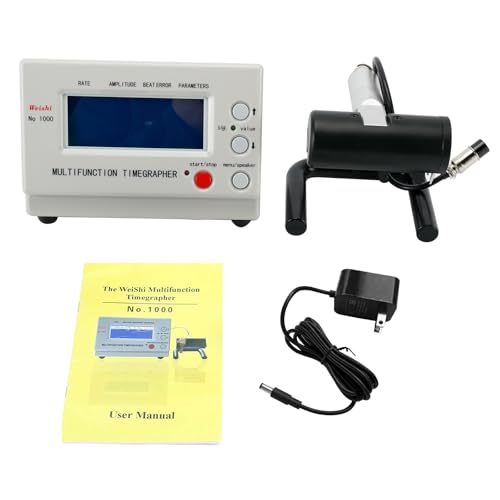
- Measures rate, amplitude, and beat error
- Six testing positions and adjustable sampling
- 3-inch LCD with live readings
Best For: Mechanical-watch collectors seeking versatile testing
Professional Diagnostics
MechanBINGOX Professional Timegrapher

- Real-time rate, amplitude, beat error, and curves
- Six-position mechanical-watch testing
- Supports four common BPH values
Best For: Watchmakers and serious mechanical-watch collectors
Compact Classic
NO.1000 Multifunction Timegrapher

- Compact 6.77 x 1.57 x 4.49-inch design
- Works with almost all mechanical watches
- Corded tool for professional or collection use
Best For: Space-conscious mechanical-watch testing
Large-Screen Upgrade

- Displays five live timing measurements
- Larger, more precise screen than No.1000
- Compatible with mechanical and coaxial watches
Best For: Collectors wanting readable, expanded diagnostics
Best Overall Compact Watch Timing Machine
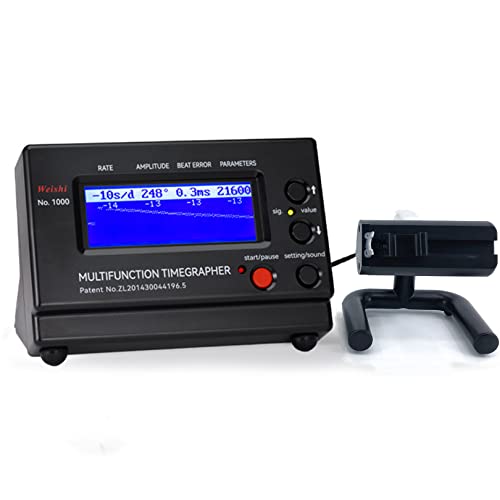
- LCD shows rate, amplitude, and beat error
- Works with most mechanical and coaxial watches
- Automatic signal adjustment and one-year warranty
Best For: Collectors, hobbyists, and professional users
Best Large-Display Compact Watch Timing Machine

- Larger LCD than the No.1000
- Supports mechanical and coaxial watches
- 100V–240V power with regional plug options
Best For: Watchmakers and collectors needing a clearer display
Best USB-C Compact Watch Timing Machine

- Measures six key timing characteristics
- Includes a USB Type-C data cable
- Enclosed cavity helps reduce testing noise
Best For: Amateur users and hobbyist watch testers
Professional Precision Pick

- ±0.1 seconds-per-day stated accuracy
- Tests six positions and key timing metrics
- Mechanical watches only
Best For: Detailed bench diagnostics and calibration
Compact Connectivity Pick

- Very small 3.94-inch-wide design
- Transfers data through USB/RS232
- Adjustable clips fit varied dial sizes
Best For: Portable testing with computer data workflows
Portable Value Pick
Multifunction No.1000 Watch Tester
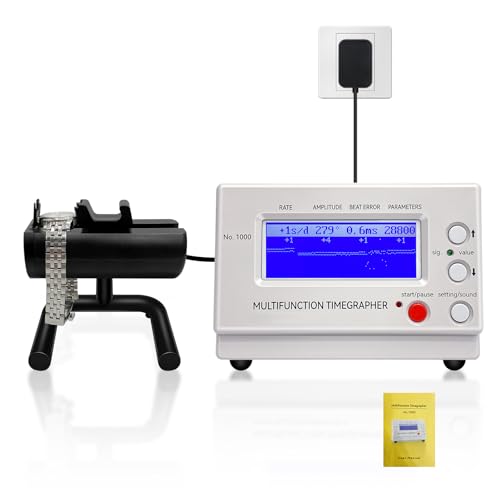
- Broad mechanical-watch measurement coverage
- Portable ABS design with color LCD
- 100V–240V input and 365-day warranty
Best For: Mobile testing and space-conscious workbenches
Best Value Setup – YaeTek NO.1000 Timegrapher
For shoppers comparing compact watch timing machines, the YaeTek NO.1000 offers a straightforward way to check a mechanical watch’s rate, amplitude, and beat error. Its LCD displays live readings, while adjustable sampling periods and six testing positions support practical at-home or collection use.
Best For: Mechanical-watch collectors who want an accessible, multifunction timing tester with adjustable testing options.
Pros:
- Measures rate, amplitude, and beat error automatically.
- Provides six adjustable testing positions.
- Offers selectable 2- to 60-second sampling periods.
- Includes a 3-inch LCD with real-time readings and visual timing lines.
Cons:
- The supplied notes do not specify a battery-powered option.
- Its 1.37 kg weight may be more than some portable setups require.
The YaeTek is a practical all-around choice when you want multiple measurements and position testing without moving beyond a familiar NO.1000-style format.
Professional Diagnostics – MechanBINGOX Professional Timegrapher
Among compact watch timing machines, this MechanBINGOX timegrapher emphasizes real-time diagnostics for watchmakers and serious collectors. It displays rate, amplitude, beat error, and timing curves, with six positions and support for several common mechanical-watch beat frequencies.
Best For: Watchmakers, repair shops, and collectors who need multi-position analysis for mechanical or automatic watches.
Pros:
- Displays rate, amplitude, beat error, and timing curves in real time.
- Tests dial-up, dial-down, and four crown positions.
- Supports 18,000, 21,600, 28,800, and 36,000 BPH.
- Uses a clear LCD for reading diagnostic data.
Cons:
- It is not designed for quartz watches.
- The supplied notes do not provide physical dimensions or weight.
Its broader diagnostic display and stated beat-frequency compatibility make it the most professionally oriented option in this selection, provided your watches are mechanical.
Compact Classic – NO.1000 Multifunction Timegrapher
If space is a priority when comparing compact watch timing machines, this NO.1000 stands out with listed dimensions of 6.77 x 1.57 x 4.49 inches. It is a corded multifunction tester for almost all mechanical watches, including coaxial models, and is positioned for both professional watchmakers and collectors.
Best For: Users who want a compact, corded timing tool for routine mechanical-watch checks.
Pros:
- Compact dimensions suit space-conscious workbenches.
- Compatible with almost all mechanical watches and coaxial watches.
- Designed for both professional and collection use.
- Meets the listed CE specification.
Cons:
- It requires corded electric power.
- The supplied notes do not list specific amplitude or beat-error features.
This model is a sensible fit when compact size and broad mechanical-watch compatibility matter more than a long list of documented display functions.
Large-Screen Upgrade – No.1900 Watch Timegrapher
The No.1900 is a strong option for shoppers comparing compact watch timing machines who prefer a larger, more detailed display. Its LCD shows live rate, amplitude, beat error, beat, and lift angle readings, and the unit is designed for almost all mechanical watches, including coaxial models.
Best For: Collectors and hobbyists who want easy setup, expanded live readings, and coaxial-watch compatibility.
Pros:
- Shows rate, amplitude, beat error, beat, and lift angle.
- Uses a larger screen than the No.1000, according to the supplied notes.
- Works with almost all mechanical watches and coaxial watches.
- Includes a stated one-year warranty and customer service support.
Cons:
- It is intended for mechanical watches rather than quartz models.
- The supplied notes do not provide physical dimensions or weight.
Choose the No.1900 when screen readability and a wider set of displayed measurements are more important than having the smallest documented footprint.
Best Overall Compact Watch Timing Machine – No.1000 Timegrapher
KINSANINC Watch Tester Timegrapher No.1000, Watch Timing Machine Calabration for Mechanical Watches
Check Price On AmazonFor collectors seeking compact watch timing machines that are easy to use, the No.1000 offers a practical way to check key mechanical-watch performance readings. Its LCD displays rate, amplitude, beat error, beat, and lift angle, while automatic signal adjustment helps simplify testing across different watches.
Best For: Watch collectors, hobbyists, and professionals who want straightforward testing for most mechanical and coaxial watches.
Pros:
- Displays rate, amplitude, beat error, beat, and lift angle on an LCD screen.
- Designed for almost all mechanical watches, including coaxial models.
- Automatically adjusts the optimal signal level for different watches.
- Includes a one-year warranty and customer support.
Cons:
- Uses corded electric power rather than a battery.
- Its plastic construction may feel less substantial than metal-bodied equipment.
The No.1000 is a well-rounded choice when ease of operation and broad mechanical-watch compatibility matter more than advanced extras. It suits routine checking at a home bench or in a professional setting.
Best Large-Display Compact Watch Timing Machine – No.1900 Coaxial Timegrapher
OTOOLWORLD New Coaxial MTG Watch Tester Timing Multifunction Timegrapher LCD Screen NO.1900
Check Price On AmazonThe No.1900 is a practical option among compact watch timing machines for users who want a larger LCD display and support for coaxial watches. Its multifunction design is intended for both professional watchmakers and watch collectors, with broad voltage compatibility for international use.
Best For: Watchmakers and collectors who prioritize a larger screen, easy operation, and coaxial-watch compatibility.
Pros:
- Features a larger LCD screen than the No.1000.
- Compatible with almost all mechanical watches and works especially well with coaxial watches.
- Designed as a multifunction timegrapher for professional and personal use.
- Supports 100V–240V power with regional mini exchange plugs.
Cons:
- Requires corded electric power.
- Regional plug compatibility may still need attention before purchase.
Choose the No.1900 if screen visibility is a priority or if coaxial-watch testing is central to your work. Its international voltage range also makes it a flexible choice for users in different regions.
Best USB-C Compact Watch Timing Machine – USB-C Timegrapher
DBEIXIWEI Watch Timegrapher with USB Type-C Data Cable Wristwatch Timing Machine Calibration Tool
Check Price On AmazonThis USB-C timegrapher is a useful choice for buyers comparing compact watch timing machines for amateur testing. Its hard-plastic housing, enclosed noise-reduction cavity, and integrated vibration sensor are designed to support measurements of rate, amplitude, beat error, frequency, lift angle, and waveform.
Best For: Amateur users who want broad mechanical-watch measurements and USB Type-C connectivity.
Pros:
- Measures rate, amplitude, beat error, frequency, lift angle, and waveform.
- Includes a USB Type-C data cable.
- Uses a vibration sensor and enclosed noise-reduction and sound-insulation cavity.
- Its microelectronic circuitry is designed not to magnetize watches during testing.
Cons:
- Specifically positioned as an instrument for amateur users rather than advanced professional workflows.
- It is not water resistant.
- The supplied notes do not specify compatibility with coaxial watches.
The USB-C model stands out for its measurement range and modern cable connection. It is a sensible fit for hobbyists who want detailed readings in a rugged plastic unit, provided water resistance and confirmed coaxial support are not priorities.
Professional Precision Pick – SWANSOFT No.1000 Timegrapher
For watchmakers seeking compact watch timing machines with broad diagnostic coverage, the SWANSOFT No.1000 combines a color LCD with precise mechanical-movement testing. It measures rate, amplitude, beat error, lift angle, and timing curves, while supporting six positions and adjustable sampling cycles.
Best For: Watchmakers, technicians, and serious mechanical-watch enthusiasts who need detailed bench diagnostics.
Pros:
- Specified accuracy of ±0.1 seconds per day using a 50-sample average.
- Measures rate, amplitude, beat error, lift angle, and timing curves.
- Supports six positions, 2–60-second sampling cycles, and a ±999 seconds-per-day range.
- Includes 12-month support and a 12-month satisfaction guarantee.
Cons:
- Designed only for mechanical watches; quartz movements are not supported.
- At 1.27 kg, it is less portable than the lightest compact options.
This is the most feature-rich choice of the three for movement diagnosis and calibration. Choose it when measurement detail and position testing matter more than minimum size or weight.
Compact Connectivity Pick – USB/RS232 Watch Timegrapher
This compact watch timing machine is suited to workspaces where portability and computer data transfer are priorities. Its acoustic pickup rail, adjustable sliding clips, and multifunction display support practical mechanical-watch calibration with a footprint of about 3.94 by 2.36 by 1.97 inches.
Best For: Users who want a lightweight tester with adjustable positioning and PC-based data transfer.
Pros:
- Compact dimensions and a listed weight of just 3.99 ounces.
- Measures daily rate, amplitude, beat error, signal value, polarization, oscillation, and waveform.
- USB/RS232 connectivity supports transferring data to tablets, laptops, and desktops.
- Removable sliding jaws accommodate different dial sizes.
Cons:
- The supplied notes do not specify measurement accuracy or supported sampling range.
- The notes describe features for mechanical-watch calibration but do not explicitly state quartz compatibility.
Pick this model when a small footprint and computer workflow are central to your setup. It offers useful flexibility, though buyers wanting clearly stated precision specifications may prefer one of the No.1000 models.
Portable Value Pick – Multifunction No.1000 Watch Tester
Among compact watch timing machines, this No.1000-style tester emphasizes portability while covering the core measurements needed for mechanical-watch servicing. Its acoustic sensor, color LCD, broad voltage input, and lightweight ABS construction make it a practical option for a mobile or space-conscious workbench.
Best For: Enthusiasts, makers, and technicians who want a portable mechanical-watch tester with broad measurement functions.
Pros:
- Measures daily rate, beat amplitude, polarity, beat error, lift angle, and period.
- Supports 2–60-second sampling, automatic standard-beat detection, and manual special-beat selection.
- Offers a ±999 seconds-per-day range and 0.1-second-per-day resolution.
- Works with 100V–240V ±10% input and includes a 365-day warranty.
Cons:
- It is intended for mechanical watches rather than quartz testing.
- The supplied notes do not provide exact external dimensions or weight.
This model balances measurement coverage with portability and worldwide voltage flexibility. It is a strong fit for users who need a capable tester they can move easily, while the SWANSOFT unit is the clearer choice for explicitly stated ultra-precision performance.
How We Picked the Best Compact Watch Timing Machines
We focused on timegraphers designed for mechanical watch testing and calibration, prioritizing useful measurements, readable displays, straightforward controls, and compact designs suited to benches or small workshops. We also considered practical differences among No. 1000 and No. 1900-style testers, multifunction layouts, acoustic pickup rails, and models that include USB Type-C data connections.
Because specifications and included accessories can vary by seller, verify the current listing for measurement ranges, power requirements, pickup design, cable compatibility, and warranty coverage before ordering.
Quick Comparison
| Feature | Why It Matters | Best For |
|---|---|---|
| Rate, amplitude, and beat error | Provides the core information needed to assess a movement | Routine regulation and diagnosis |
| LCD display | Makes readings easier to view while positioning a watch | Workbenches and repeated testing |
| Acoustic pickup rail | Helps detect the movement’s beat signal | Traditional timing-machine setups |
| USB Type-C connection | May simplify power or data use, depending on the model | Modern workspaces and portable setups |
| Multifunction operation | Combines several timing measurements in one device | Collectors, technicians, and hobbyists |
Key Buying Factors for Compact Watch Timing Machines
Measurements and Beat Support
At minimum, look for daily rate, amplitude, and beat error readings. A broad beat-number range is useful if you work on watches from different manufacturers. Confirm that the tester supports the movements you service rather than assuming similarly named models have identical capabilities.
Pickup Quality and Positioning
A stable acoustic pickup and secure rail can improve consistency, especially when testing watches in multiple positions. The machine should hold the case firmly without scratching it, while still allowing quick repositioning for dial-up, dial-down, and vertical tests.
Display, Controls, and Data Handling
Choose a clear display with controls you can use without interrupting the watch’s position. USB connectivity can be convenient, but check whether it is intended for power, data transfer, or both. If you need records for customers or long-term regulation work, confirm software and export support before buying.
Size, Power, and Accessories
Compact machines save bench space, but portability should not come at the expense of stability. Check dimensions, power input, included adapters, pickup cables, and replacement-accessory availability. A complete kit may offer better value than a lower-priced unit that requires separate essentials.
Who Should Buy Which Compact Watch Timing Machines?
Choose a basic No. 1000-style tester if you need an affordable way to check rate, amplitude, and beat error during occasional regulation. Choose a No. 1900-style or LCD multifunction model if you want a more feature-focused bench instrument for frequent testing. Choose a USB Type-C model when modern connectivity or flexible power is important, but confirm its exact USB functions first. Choose a model with a dedicated acoustic pickup rail if secure positioning and repeatable readings are priorities.
For most buyers, the best Compact Watch Timing Machines are not necessarily the most elaborate. Select the unit with the measurements, beat support, pickup design, and connectivity that match your watches and workflow, then verify calibration and seller support before purchase.