
10 Best Watch Timing Machines for Hobbyists in 2026: Practical Picks for Accurate Mechanical Watch Testing
Mechanical watches can appear to run well while still gaining or losing noticeable time each day. A watch timing machine gives hobbyists a clearer view of rate, amplitude, beat error, and beat frequency than visual observation alone.
We selected 10 timegraphers with different feature sets, display styles, and intended uses. The guide below explains what to compare before choosing one for home testing, regulation, or a growing watchmaking bench.
Page Contents
- Best 10 Watch Timing Machines for Hobbyists Picks for 2026
- Accessible Pick – YaeTek No.1000 Watch Timegrapher
- Professional Hobbyist Choice – MechanBINGOX Six-Position Timegrapher
- Large-Screen Option – No.1900 Coaxial Watch Timegrapher
- Precision-Focused Pick – SWANSOFT No.1000 Timegrapher
- Pocket Watch Setup – Ewatchparts Multifunction Timegrapher 1000
- Large LCD Readout – No.1900 Watch Tester Timegrapher
- Compact Workshop Tool – No.1000 Watch Timing Machine
- Easy-Start Pick – No.1000 Watch Timegrapher
- Display Upgrade – No.1900 Multifunctional Timegrapher
- Precision Workbench Tool – Multifunctional No.1000 Tester
- How We Picked These Watch Timing Machines for Hobbyists
- Quick Comparison
- Key Buying Factors for Watch Timing Machines for Hobbyists
- Who Should Buy Which Watch Timing Machines for Hobbyists?
- Read More Articles
- Best Sports Coats For Business Casual
- Best Watch Timing Machine
- Best Compact Watch Timing Machines
- Best Watch Timing Machines With Carrying Cases
- Best Watch Timing Machine For Home Use
- Best Watch Timing Machines For Watchmakers
- Best Watch Timing Machines For Small Workshops
- Best Watch Timing Machine Under 200
- Best Watch Timing Machines Under 50
- Best Jewelry Magnifiers
Best 10 Watch Timing Machines for Hobbyists Picks for 2026
Accessible Pick
YaeTek No.1000 Watch Timegrapher
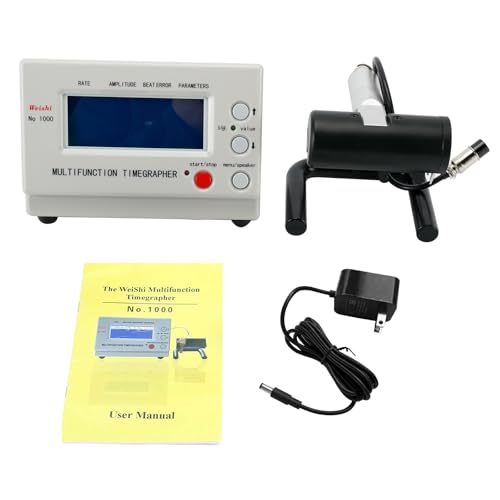
- Measures rate, amplitude, and beat error
- Six positions with 2–60-second sampling
- LCD timing curves and live readings
Best For: Mechanical-watch collectors seeking simple home testing
Professional Hobbyist Choice
MechanBINGOX Six-Position Timegrapher

- Real-time rate, amplitude, and beat-error readings
- Six-position mechanical-watch testing
- Supports 18,000–36,000 BPH movements
Best For: Collectors and hobbyists evaluating movement consistency
Large-Screen Option
No.1900 Coaxial Watch Timegrapher

- Larger LCD than the No.1000
- Works with mechanical and coaxial watches
- 100V–240V power with regional plug options
Best For: Users prioritizing display size and coaxial-watch testing
Precision-Focused Pick

- Claims ±0.1 s/d accuracy with 50-sample averaging
- Measures lift angle and multiple timing metrics
- Six positions with color LCD timing curves
Best For: Advanced hobbyists and technicians tuning mechanical watches
Pocket Watch Setup
Ewatchparts Multifunction Timegrapher 1000

- Listed for pocket-watch compatibility
- Multifunction timegrapher design
- Requires model and size verification
Best For: Hobbyists testing compatible pocket watches
Large LCD Readout
No.1900 Watch Tester Timegrapher

- Shows five live timing measurements
- Works with coaxial mechanical watches
- Includes one-year warranty
Best For: Collectors wanting a readable, easy-to-use display
Compact Workshop Tool

- Tests almost all mechanical watches
- Includes coaxial testing
- Compact corded design
Best For: Hobbyists needing a straightforward mechanical-watch tester
Easy-Start Pick
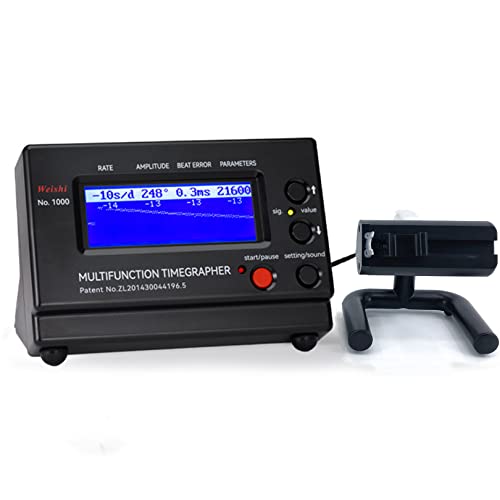
- Live rate, amplitude, and beat-error readings
- Works with most mechanical and coaxial watches
- Automatic signal adjustment and one-year warranty
Best For: Collectors and hobbyists wanting simple routine timing checks
Display Upgrade
No.1900 Multifunctional Timegrapher

- High-resolution color display with two trace colors
- Measures rate, amplitude, beat error, and lift angle
- Supports one to six positions and 100V–240V AC
Best For: Users who want clearer traces and deeper troubleshooting
Precision Workbench Tool
Multifunctional No.1000 Tester
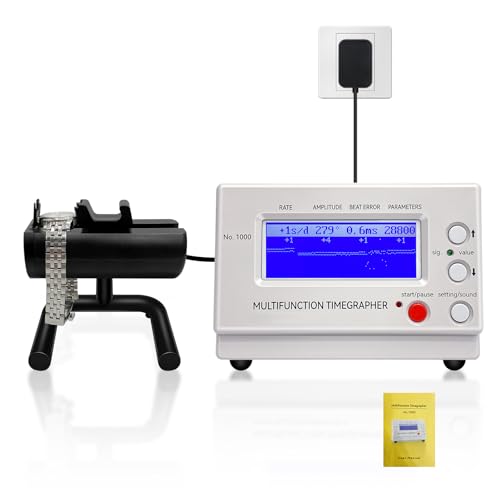
- Checks rate, amplitude, polarity, beat, lift angle, and period
- Offers adjustable sampling and one-to-six-direction testing
- Compact ABS unit with 100V–240V input
Best For: Enthusiasts and technicians needing detailed movement diagnosis
Accessible Pick – YaeTek No.1000 Watch Timegrapher
For hobbyists comparing watch timing machines for hobbyists, the YaeTek No.1000 offers a straightforward way to check a mechanical watch’s rate, amplitude, and beat error. Its LCD provides live readings and timing curves, while selectable sampling periods help you review results over different test durations.
Best For: Mechanical-watch collectors who want an approachable, multi-position timing tester.
Pros:
- Automatically calculates rate, amplitude, and beat error.
- Supports six testing positions and sampling periods from 2 to 60 seconds.
- LCD screen shows live readings with moving timing lines.
Cons:
- Designed for mechanical watches rather than quartz models.
- The listed amplitude level range is 275–315, which may be limiting for some evaluations.
This is a practical entry point for routine checks, especially if you value simple controls and visual feedback. The 110V–220V US-plug configuration also suits many home workbench setups.
Professional Hobbyist Choice – MechanBINGOX Six-Position Timegrapher
The MechanBINGOX timegrapher is aimed at shoppers seeking watch timing machines for hobbyists with a more diagnostic focus. It displays rate, amplitude, beat error, and timing curves in real time, and its six-position testing helps reveal how a mechanical movement performs in different orientations.
Best For: Hobbyists, collectors, and small repair benches working with common mechanical and automatic movements.
Pros:
- Measures rate, amplitude, beat error, and timing curves.
- Tests dial-up, dial-down, and four crown positions.
- Supports common frequencies from 18,000 to 36,000 BPH.
Cons:
- Not designed for quartz watches.
- The supplied notes do not specify a sampling range or lift-angle adjustment.
Its clear real-time display and broad compatibility with common beat frequencies make it a versatile choice for routine regulation checks. The stated lifetime warranty is an additional consideration for long-term ownership.
Large-Screen Option – No.1900 Coaxial Watch Timegrapher
OTOOLWORLD New Coaxial MTG Watch Tester Timing Multifunction Timegrapher LCD Screen NO.1900
Check Price On AmazonAmong watch timing machines for hobbyists, the No.1900 stands out for its larger LCD screen and stated suitability for coaxial watches. It is designed for most mechanical watches and offers a multi-purpose format that can work for both collection monitoring and more regular bench use.
Best For: Mechanical-watch owners who want a larger display and better support for coaxial watches.
Pros:
- Larger LCD screen than the No.1000 model.
- Designed for almost all mechanical watches and coaxial watches.
- Uses 100V–240V power with interchangeable regional plugs.
Cons:
- The supplied notes do not list specific rate, amplitude, or beat-error ranges.
- Its corded-electric design may be less convenient for portable setups.
The No.1900 is most compelling when screen visibility and coaxial-watch compatibility matter more than published measurement specifications. Its broad voltage support is useful for users who may work across different regions.
Precision-Focused Pick – SWANSOFT No.1000 Timegrapher
The SWANSOFT No.1000 is a strong contender for shoppers comparing watch timing machines for hobbyists who want detailed movement diagnostics. It measures rate, amplitude, beat error, and lift angle, provides timing curves on a color LCD, and supports six testing positions with selectable 2–60-second sampling cycles.
Best For: Enthusiasts and technicians who want broader measurement controls for mechanical-watch regulation.
Pros:
- Lists ±0.1 s/d accuracy with a 50-sample average and a ±999 s/d range.
- Measures rate, amplitude, beat error, lift angle, and timing curves.
- Supports six positions, 2–60-second sampling, and adjustable 30°–70° lift angles.
Cons:
- Only supports mechanical movement watches, not quartz watches.
- Its broader controls may be more than casual users need.
With its extensive measurement set and color display, this model is suited to users who want more than a basic pass-or-fail timing check. The included 12-month satisfaction guarantee and stated lifetime warranty provide additional ownership support.
Pocket Watch Setup – Ewatchparts Multifunction Timegrapher 1000
Ewatchparts Watch Timing Machine Multifunction Timegrapher 1000 Compatible With Pocket Watch
Check Price On AmazonFor hobbyists seeking watch timing machines for hobbyists, this Ewatchparts multifunction timegrapher is specifically listed as compatible with pocket watches. Check your watch model and measure the required size before ordering, since compatibility is model- and size-specific.
Best For: Hobbyists testing compatible pocket watches.
Pros:
- Designed for pocket-watch compatibility.
- Multifunction timegrapher format for timing checks.
- Compact 2-inch item length.
Cons:
- Compatibility and fit must be verified before purchase.
- Listed as an aftermarket or generic product.
This is a focused option for pocket-watch owners who want a dedicated timing tool, but careful measurement and model verification are essential before buying.
Large LCD Readout – No.1900 Watch Tester Timegrapher
The No.1900 is a practical choice among watch timing machines for hobbyists who want an easy-to-read display. Its LCD screen shows live rate, amplitude, beat error, beat, and lift angle readings, and it is described as suitable for almost all mechanical watches, including coaxial watches.
Best For: Watch collectors and hobbyists who want a larger digital display and broad mechanical-watch compatibility.
Pros:
- LCD screen displays rate, amplitude, beat error, beat, and lift angle.
- Designed to work with almost all mechanical watches and coaxial watches.
- Described as easy to use out of the box.
- Includes a one-year warranty and customer service support.
Cons:
- Requires AC power.
- Its listed scope is mechanical watches, not general watch testing.
With its larger screen and stated coaxial-watch support, the No.1900 is the most feature-forward option here for hobbyists who value readable live measurements and straightforward operation.
Compact Workshop Tool – No.1000 Watch Timing Machine
This No.1000 timegrapher is a compact, corded option for hobbyists comparing watch timing machines for hobbyists. It is designed for almost all mechanical watches, includes coaxial testing, and uses beats-per-unit-time measurement for timing analysis.
Best For: Hobbyists and collectors seeking a compact corded tester for mechanical watches.
Pros:
- Compatible with mechanical watches, including coaxial testing.
- Compact dimensions of 6.77 x 1.57 x 4.49 inches.
- Uses beats-per-unit-time measurement.
- Listed as popular with professional watchmakers and collectors.
Cons:
- Requires corded electric power with a listed minimum operating voltage of 100 volts.
- The supplied details do not mention an LCD screen or warranty.
The No.1000 keeps the feature set focused on mechanical-watch timing and coaxial testing. Its compact format may suit a hobby bench, provided corded operation fits your workspace.
Easy-Start Pick – No.1000 Watch Timegrapher
KINSANINC Watch Tester Timegrapher No.1000, Watch Timing Machine Calabration for Mechanical Watches
Check Price On AmazonFor hobbyists comparing watch timing machines for hobbyists, the No.1000 is a straightforward corded tester for checking key performance readings on mechanical watches. Its LCD screen displays rate, amplitude, beat error, beat, and lift angle, and it automatically adjusts the signal level between watches.
Best For: Watch collectors and hobbyists who want an easy-to-use timegrapher for routine checks on mechanical and coaxial watches.
Pros:
- Shows rate, amplitude, beat error, beat, and lift angle live.
- Designed to work with almost all mechanical watches, including coaxial models.
- Automatically adjusts the optimal signal level for different watches.
- Includes a one-year warranty and customer support.
Cons:
- Uses a monochrome-style LCD presentation rather than a more advanced color display.
- Its supplied features are focused on core timing checks rather than broader diagnostic functions.
The No.1000 is a sensible entry point when ease of use matters more than advanced visualization. It covers the measurements most hobbyists need for basic performance monitoring without adding unnecessary complexity.
Display Upgrade – No.1900 Multifunctional Timegrapher
The No.1900 stands out among watch timing machines for hobbyists with its larger high-resolution color screen and two-color trace display. It measures rate deviation, amplitude, and beat error while showing beat number and lift angle, making it useful for both routine checks and troubleshooting.
Best For: Hobbyists and watchmakers who want clearer visual traces, multiple measuring positions, and more detailed mechanical-watch diagnostics.
Pros:
- Color screen uses yellow and light-blue traces to distinguish entrance and exit pings.
- Measures rate deviation, amplitude, beat error, beat number, and lift angle.
- Supports one to six measuring positions and mechanical or coaxial watches.
- Includes a sensor, US adapter, manual, and cleaning cloth.
Cons:
- Its broader diagnostic feature set may be more than casual users need.
- The supplied details do not identify a battery option; it uses AC 100V–240V power.
Choose the No.1900 if interpreting timing traces is part of your workflow. The color display and entrance-versus-exit trace separation provide a clearer diagnostic view than the No.1000, while the intuitive interface keeps operation approachable.
Precision Workbench Tool – Multifunctional No.1000 Tester
This multifunctional No.1000 is aimed at enthusiasts seeking more detailed measurements from watch timing machines for hobbyists. It checks daily rate, beat amplitude, polarity, beat, lift angle, and period, with adjustable sampling and directional measurements for mechanical-watch diagnosis.
Best For: Hobbyists, makers, and technicians who want a compact workbench tester with detailed readings and flexible measurement settings.
Pros:
- Measures daily rate, amplitude, polarity, beat, lift angle, and period.
- Offers a 2–60-second sampling period and one to six directional measurements.
- Provides a ±999 seconds-per-day range with 0.1 seconds-per-day resolution.
- Compact design, 100V–240V input, and a stable zinc-alloy microphone base.
Cons:
- Its advanced settings may require more time to learn than a basic tester.
- It is not water resistant, so it should remain protected from moisture on the workbench.
With its polarity reading, dense sampling, and adjustable test controls, this model is better suited to users who want to investigate movement behavior rather than only confirm daily accuracy. Its portable design also helps when desktop space is limited.
How We Picked These Watch Timing Machines for Hobbyists
We focused on the measurements that matter most during mechanical-watch testing: rate, amplitude, beat error, beat frequency, and the ability to show results clearly across multiple positions. We also considered practical details such as microphone sensitivity, display readability, control simplicity, footprint, and whether the machine is suited to wristwatches, pocket watches, or both.
Many products in this category use similar No.1000 or No.1900 naming, so model labels alone should not determine your choice. Check the listing carefully for included accessories, supported beat rates, power requirements, and the exact functions available.
Quick Comparison
For straightforward home diagnostics, a multifunction No.1000-style timegrapher is often sufficient. No.1900-style units may be preferable when you want a larger LCD interface or broader adjustment options. A coaxial-compatible model can be useful for owners of watches with less conventional escapement behavior, while a pocket-watch-compatible tester offers more flexibility for larger cases.
Regardless of the label, compare whether the unit displays all core readings simultaneously, supports manual or automatic beat detection, and lets you change lift angle when required. These features have a greater effect on usefulness than cosmetic differences between nearly identical-looking machines.
Key Buying Factors for Watch Timing Machines for Hobbyists
Measurements and Display
Choose a tester that clearly reports daily rate, amplitude, beat error, and beat frequency. A bright, readable screen is especially helpful when the machine sits on a crowded bench. Graphs or trace lines can also make beat consistency easier to interpret.
Lift Angle and Beat-Rate Support
Lift angle settings should match the movement being tested. An incorrect setting can make amplitude readings misleading, even if the rate appears plausible. Broad beat-frequency support is valuable if you work on watches from different manufacturers.
Microphone and Stability
A dependable microphone and stable watch holder help prevent noisy traces and inconsistent readings. Look for a firm platform, adjustable positioning, and enough sensitivity for the watches you expect to service. Pocket watches may require a different holder position than typical wristwatches.
Ease of Use and Bench Fit
Hobbyists usually benefit from simple controls, quick setup, and a compact footprint. If you expect to test several watches in one session, prioritize a clear interface and easy switching between positions rather than choosing solely on the lowest price.
Who Should Buy Which Watch Timing Machines for Hobbyists?
Choose a basic multifunction timegrapher if you mainly want to check whether a watch is running fast or slow and compare positions before attempting regulation.
Choose a larger-screen or No.1900-style unit if display visibility, expanded controls, or more frequent bench use matter most. These models can be more comfortable for repeated testing.
Choose a coaxial-compatible tester if your collection includes watches with coaxial escapements and you want a model marketed specifically toward that testing scenario.
Choose a pocket-watch-compatible option if you service both wristwatches and larger pocket watches. Otherwise, a standard holder may be simpler and more compact.
Before buying, confirm the seller’s specifications and included equipment, then match the machine to your movements, workspace, and experience level. A timegrapher is a diagnostic tool, not a substitute for proper cleaning, lubrication, or professional service.